Academic Integrity & Assessment Practices
Overview & Vision
As we align our division around Clarity, Consistency, and Integrity, we are updating how we approach course outlines, academic integrity, and final exams.
Historically, legacy course materials—particularly within legacy BCOS courses—relied on rigid, systemic "policies" (such as the automatic sliding-scale exam weighting formula). We are retiring legacy, course-specific assessment policies and transitioning from rigid policy to relational practice.
Our goal is not to lower standards, but to elevate authentic learning through strong teacher-student relationships, proactive course design, and teacher professional judgment.
Retiring Legacy Assessment Policies
Legacy course materials may have previously outlined automated exam weighting rules based on percentage gaps between coursework and proctored final exams.
-
The Legacy Policy to Remove: Automatically shifting exam weighting to 50%, 70%, or 100% of a student's final grade based strictly on a numerical variance between coursework and the final exam.
-
The Shift: Course outlines serve as general guides for what students can expect in a typical course experience. However, reasonable adjustments and shifts can be made by the teacher when necessary to ensure an accurate, honest assessment of each student's independent ability.
Teachers are asked to review their Brightspace course shells, course outlines, and introductory news items for the upcoming school year to remove legacy policy language and update it to reflect our modern assessment practices.
Language Shift: From "Policy" to "Practice"
If you wish to retain a framework similar to the BCOS exam guidelines within your course outline, you may do so—however, we ask that you update your language to replace the word "policy" with "practice." This should also include that before this practice may be applied students will be given the opportunity for a discussion with their teacher.
-
Why the Shift?
A "policy" implies an automated, rigid rule that must be applied mechanically regardless of circumstances. A "practice" reflects an intentional, professional approach that guides how learning is evaluated while maintaining flexibility for teacher discretion. -
Using Weighting Adjustments
Adjusting exam or coursework weighting remains a valid tool teachers may use to ensure a final grade accurately reflects a student's independent ability, however this should not happen without a conversation and an in person meeting to verify proficiency. Rather than applying automatic percentage shifts, weighting adjustments should be chosen deliberately by the teacher as part of a holistic evaluation and part of triangulation.
Ministry Alignment: Professional Judgment & Triangulation
Under BC Ministry of Education guidelines, classroom teachers hold the professional flexibility and responsibility to design and adjust evaluation frameworks. Rather than relying on a single exam score or automated formula, teachers use their professional judgment to assess learning.
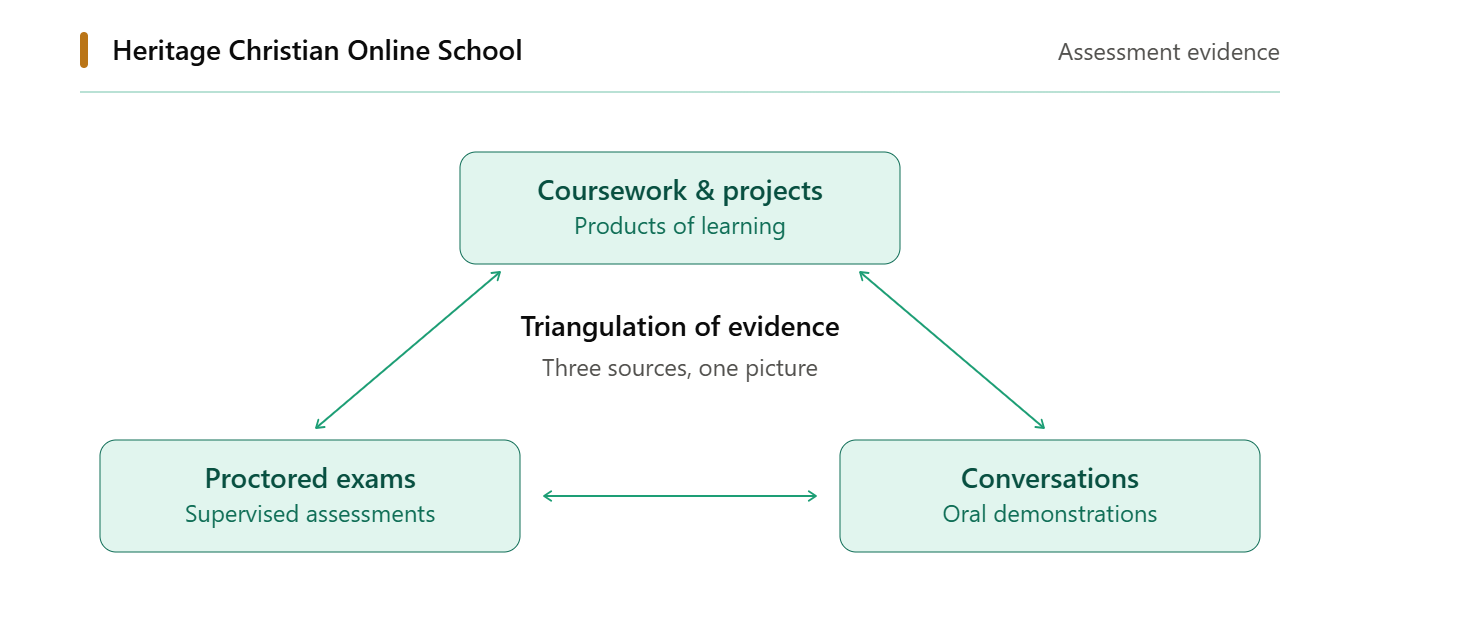
When a significant discrepancy occurs between day-to-day coursework and a proctored final exam, teachers should triangulate evidence of learning:
-
Coursework & Products: Reviewing regular assignments, quizzes, and project submissions over time.
-
Proctored Assessments: Evaluating performance on proctored final exams.
-
Conversations & Observations: Engaging the student directly through online calls, interviews, or oral demonstrations to evaluate understanding.
If an exam mark differs significantly from coursework, the teacher uses these three pillars to determine an accurate final grade that reflects the student's true independent ability.
Proctored Exam Procedures & Integrity
Proctored final exams remain an important tool for verifying independent student learning in an online environment.
How Proctored Exams Work
-
Proctoring Platform: Core courses utilize Integrity Advocate, an online proctoring service that records students via webcam during the exam and reviews footage for academic integrity concerns. Teachers can choose where in their course to use the proctored system (beginning, middle, end etc.)
-
Student Setup: The course teacher is responsible for ensuring the student is set up and scheduled for their exam at their desired time.
-
Technical Support: If a student experiences technical difficulties before or during an exam, they must contact their teacher directly. Central school IT teams cannot resolve technical issues within the third-party proctoring system.
Addressing Academic Integrity Through Relational Practice
We recognize teacher concerns regarding the removal of strict weighting language. Proctored exams are often one of the few fully supervised pieces of evidence in an online course. However, maintaining integrity works best through proactive engagement and direct dialogue.
Recommended Strategies for Teachers
-
Early Verification Checks: Do not wait until the final exam to verify student identity and independent work. Build in small, early verification checks (e.g., short 5-minute video check-ins or quick oral reflections) near the beginning or middle of the course to catch discrepancies early.
-
Proctored Group Exams During Office Hours: Utilize your scheduled office hours as group test-writing opportunities. Teachers can require students to log in to Zoom during designated office hours to write their unit tests or exams live under teacher supervision. This builds routine, reduces reliance on third-party software for mid-term checks, and fosters a supportive environment. These can be hosted as group sessions.
-
Slow the Process Down: Use Brightspace conditional release settings to gate access to major assessments. Requiring prerequisite work or foundational benchmarks before unlocking exams prevents work "dumping" and sudden rushes at reporting deadlines.
-
Relational Touchpoints: When a discrepancy or academic integrity concern arises, schedule a Zoom call with the student. A short conversation allows the student to verbally demonstrate knowledge, clarify their process, and discuss potential test anxiety or learning barriers.
Course Outline & Announcement Messaging Guidance
When updating your course shells, use language that emphasizes clarity, support, and professional evaluation.
Sample Course Outline Language:
"This course outline provides a roadmap of course expectations and evaluation structures. To ensure grades accurately reflect each student's independent understanding, assessments are evaluated using teacher professional judgment across coursework, invigilated exams, and direct conversations. Adjustments to assessment structures may be made when necessary to support and accurately verify student learning."
"This course outline provides a roadmap of course expectations and evaluation structures. To ensure grades accurately reflect each student's independent understanding, assessments are evaluated using teacher professional judgment across coursework, invigilated exams, and direct conversations. Students are expected to log in during designated office hours to complete supervised tests on Zoom or utilize our proctoring system as scheduled. Adjustments to assessment structures may be made when necessary to support and accurately verify student learning."
Questions & Support
If you need assistance updating your course shell language, configuring conditional release settings in Brightspace, or navigating a complex student assessment situation, please reach out.