Safety Policies
- Anaphylaxis Policy
- Field Trip Safety Policy
- Bus & Transportation Safety Policy
- Child Abuse Reporting Protocols
- Communicable Disease Prevention Protocols
- First Aid Policy
- Safety Hazard Reporting
- Water Testing Policy
- Student Supervision Policy
- Student Transportation Policy
Anaphylaxis Policy
Anaphylaxis is: is a severe allergic reaction that can be fatal, resulting in circulatory collapse or shock. The allergy may be related to food, insect stings, medicine, latex, nuts, etc. The purpose of the policy is to provide an outline for prevention and care for a student with a known anaphylactic response.
Anaphylaxis Policy
Upon student application, if a medical alert - life threatening or severe medical condition - is noted, the parent is asked to complete the medical planning form provided by the school.
For Parent Accompanied Events:
- Expectation of Parent to assume parental responsibility, carry the epi-pen and administer if needed.
For school run events:
- We require a Permission to Administer Medicine form (updated annually)
- Parent provides Epi-pen onsite
- Stored appropriately with Teacher/ supervisor access and kept nearby
- All those in care of the student throughout the day provided with a copy of the Medical Planning Form and aware of the epi-pen’s location
- Annual staff training with local school nurse provided
- review signs and symptoms
- common allergens
- avoidance strategies
- How to use/administer epinephrine auto-injector
- Discussions to raise team and participant awareness
- Your local school nurse is also a valuable resource and may provide practical training as needed
- Free anaphylaxis training, video/quiz/certificate Allergy Aware Website
In Case of Anaphylaxis
- Allergic response is immediately treated with epi-pen, not Benadryl
- 911 is called
- Parent to be notified
- Flex representative to accompany to hospital awaiting parent arrival
- Flex representative to call Director of Flex Academy and complete the Accident Report Form.
- Director follows up with family and staff to consider future care considerations
- Student allergy alert information noted within Encom for future reference with note for parents encouraging use of Medic-Alert identification
Field Trip Safety Policy
Flex Academy affirms the educational value of well-planned and well-supervised curricular and extracurricular field trips. The primary purpose of these trips should be to enhance the participants' educational experiences. These experiences enrich the curriculum and provide opportunities for young people to encounter the world around them in ways not provided for in a school setting. Such trips will supplement the curricular and extracurricular programs in the school. Flex Academy field trips are placed into one of four levels, as described below.
Level One Field Trips
Level One Field Trips are classified as being one day or less in duration and the activities do not have risk factors. Parents can expect a notice sent home that has date, destination, departure and arrival times, nature and purpose of the activity, transportation information, financial arrangements and volunteer signup (if any). Risk factors for this level are considered minimal.
Examples: farms, parks, museums, concerts, supervised pools, etc.
Level Two Field Trips
Level Two Field Trips are categorized as being out of city or overnight in duration. This category of excursion has minimal risk factors. Parents can expect a notice sent home that has a parental signature for consent, date, destination, departure and arrival times, nature and purpose of the activity, transportation information, financial arrangements, and volunteer signup (if any). School Administration must sign off for this level of field trip.
Examples: overnight sports tournaments, overnight retreats, music tours, mission festivals, geography trips, drama trips, etc.
Level Three Field Trips
Level Three Field Trips take place within the province of BC, may be more than one day in duration, and are classified as having inherent risk factors. Therefore, parents may expect a parent meeting depending on the risk factors involved, can expect a notice sent home that has detailed communication. It would include a parental signature for consent, date, destination, departure and arrival times, nature and purpose of the activity, transportation information, financial arrangements, and volunteer signup (if any). The school administration must sign off for this level of field trip.
Examples: downhill skiing and snowboarding, ice skating, road cycling, and mountain biking.
Level Four Field Trips
Level Four Field Trips this level of field trip generally occurs outside of the province of British Columbia and is reviewed on a case by case basis by the administration and school committee. Parents will be informed of the international excursion in writing detailing information such as accommodations, transportation, contact information, and approximate itinerary. Meetings between administration, chaperones, and students will also take place prior to the trip. Administration and chaperones will then collect information needed for each student involved including medical concerns, allergies, vaccinations, necessary medications as well as any other medical requirements. Additionally, administration and chaperones will ensure that out-of-province/country medical coverage is obtained.
Flex Academy administration and chaperones will rely on the advice of Canada’s travel advice and advisories pages located at https://travel.gc.ca.
It is important to note that trips will not be approved to countries where an “Avoid Non-Essential Travel” advisory exists. Prior to departure for trips, the current status of a destination must be checked. Approval for a trip will be withdrawn should an “Avoid Non-Essential Travel” advisory exist. Additionally, should extreme weather exist or be predicted, approval can be withdrawn. When such circumstances arise, Flex Academy will only reimburse funds that can be recovered. All such trips must be approved by a designated member of the Flex Academy administrative team, the HCOS Administration and at a minimum require a parental permission form which includes a declaration of potential risk.
Examples: SEALS Travel and Comparative Civilizations 12.
General Field Trip Guidelines
School administration and personnel will make every effort to ensure that financial requirements do not exclude students from participation on a field trip. Depending on the level of field trip, students may be required to be an active and contributive member during fundraising events.
School standards of behavior and conduct will apply to all field trips. Parents of children who have been identified as safety risks or behavioral concerns will be notified that there must be a parent or family member present for the activity.
When a bus is not available and parent drivers are relied on for transportation, drivers must provide a valid driver’s license, current insurance with a minimum liability of $2,000,000 with supported documentation on file. Parents will need to give permission for this mode of transportation. Please refer to the parent drivers section in the school handbook.
Adult to student ratio is dependent on age and activity.
Please ensure that your emergency and medical contact information are up to date, as the teachers are required to bring medical information on each trip.
Level 1 - Local, Low-Risk Field Trip
(Includes visits to farms, parks, museums, concerts, supervised pools, etc.)
After making all the arrangements, please check to make sure you cover all the following items:
Pre-trip
-
Inform school administration and office staff
-
Book the bus if needed
-
Document and go over safety and/or class management expectations
-
Have a ride home planned for students who breech conduct expectations
-
Arrange for enough supervisors/helpers
Inform parents
-
date and destination of trip
-
departure and return times
-
teacher in charge and contact information
-
nature and purpose of activity
-
transportation information
-
parent volunteer sign-up (if desired)
-
financial arrangements (if any)
During trip
-
Bring emergency forms and pertinent medical information
-
Bring an emergency first aid kit
-
Document and go over safety and/or class management expectations
Post-trip
-
Follow-up accident reports
-
Return emergency and first aid materials
Level 2: Out-of-Town or Overnight Field Trip Checklist
Examples include overnight sports tournaments, overnight retreats, music tours, mission festivals, geography trips, drama trips, etc.
After making all the arrangements, please check to make sure you cover all the following items:
Pre-trip
-
Inform principal and office
-
Book the bus if needed
-
Document and go over safety and/or class management expectations
-
Have a ride home planned for students who breech conduct expectations
-
Arrange for enough supervisors/helpers
Inform parents
-
date and destination of trip
-
departure and return times
-
teacher in charge and contact information
-
nature and purpose of activity
-
transportation information
-
detailed itinerary
-
parent volunteer sign-up (if desired)
-
financial arrangements (if any)
-
volunteer sign-up (if any)
-
risks (if any)
-
date of parent meeting for medium to high-risk trips
-
parental signature for acknowledgement
During trip
-
Bring emergency forms and pertinent medical information
-
Bring an emergency first aid kit
-
Document and go over safety and/or class management expectations
Post-trip
-
Follow-up accident reports
-
Return emergency and first aid materials
Level 3: Inherent Risk Field Trip Checklist
Examples includes downhill skiing/snowboarding, ice skating, road cycling, mountain biking, etc.
After making all the arrangements, please check to make sure you cover all the following items:
Pre-trip
-
Inform principal and office
-
Book the bus if needed
-
Document and go over safety and/or class management expectations
-
Have a ride home planned for students who breech conduct expectations
-
Arrange for enough supervisors/helpers
Inform parents
-
date and destination of trip
-
departure and return times
-
teacher in charge and contact information
-
nature and purpose of activity
-
transportation information
-
detailed itinerary
-
parent volunteer sign-up (if desired)
-
financial arrangements (if any)
-
volunteer sign-up (if any)
-
risks (if any)
-
date of parent meeting for medium to high risk trips
-
parental signature for acknowledgement
During trip
-
Bring emergency forms and pertinent medical information
-
Bring emergency first aid kit
-
Document and go over safety and/or class management expectations
Post-trip
-
Follow-up accident reports
-
Return emergency and first aid materials
Level 4: Out-of-Province/ Country Field Trip Checklist
Examples include Comparative Civilizations 12 and Impact Ministries
After making all the arrangements, please check to make sure you cover all the following items:
Pre-trip
-
Complete Pre-Trip Safety Checklist
-
Complete Emergency Response Plan
-
Document and go over safety and behaviour expectations
-
Provide Trip Itinerary, Routes, and Map
-
The application form must provide
-
Exit Plan for students who breach conduct expectations
-
Provide Contact Information (e.g., cell phone)
-
Arrange for enough supervisors/helpers
-
Inform parents (written and formal meeting)
Application Package
-
student’s personal and medical information
-
parent and emergency contact information
-
Itinerary and planned activities:
-
date and destination of the trip
-
purpose and educational goals
-
departure and return times
-
method of transportation
-
supervisory arrangements
-
financial costs and fees
-
potential known risks
-
detailed itinerary
-
notarized form of consent and acknowledgment of risk
-
student covenant
During trip
-
Bring emergency forms and pertinent medical information
-
Bring emergency first-aid kits
-
Document and go over safety and behaviour expectations
-
Provide cell phone for student excursions
Post-trip
-
Follow-up incident reports
-
Return emergency and first aid materials
Health Emergency Procedure
- Regarding an Anaphylaxis emergency, please review this procedure
- Emergency Communication Procedure can be found here
Bus & Transportation Safety Policy
1.0 Definitions
1.1 In this Bus Safety Policy, the following terms have the meanings set out below:
1.1.2 “inspection” means an assessment of the safe condition of the bus.
1.1.3 “driver” means the parent, guardian, or other legal representative of a student.
1.1.4 “student” means a current student of Flex Academy or Heritage Christian Online School.
1.1.5 “the school” means Flex Academy and its parent Kelowna Christian Center Society.
1.1.6 “rules” means an expected code of conduct for students riding the bus
1.1.7 “evacuation” means the removal of students from the bus in a potentially dangerous situation
2.0 General
2.1 Flex Academy believes that field trips are a necessary part of education, so we have committed time and resources to use our own school buses for transportation to these field trips. The Flex bus is owned and operated by the school and its personnel, so we believe the bus is an extension of the school. Students travelling on school buses are under the jurisdiction of their principal and are subject to the code of conduct of Flex Academy.
3.0 Inspections
3.1 Flex Academy will ensure that the buses are in safe operating condition before they go out with students in them. The school will:
3.1.1 Have mechanical inspections done twice a year
3.1.2 Have yearly decals updated on the bus from the official ministry of transportation inspectors
3.1.3 Have pre-trip inspections done each day before a bus goes out on a field trip.
3.1.4 Have suitable insurance in place
4.0 Drivers
4.1 Drivers are expected to have an up-to-date professional class 1, 2 or 4 license. Drivers may be asked to have a copy of their drivers extract on record.
4.2 Drivers are responsible for pre-trip inspections. If the safety of the vehicle is under question, or if the road conditions are unsafe, the driver is authorized to cancel the use of the bus and have the school make other arrangements for the field trip.
4.3 Drivers should know the state and placement of the first aid kit, the fire extinguisher and snow chains, emergency exits and flares/triangle.
4.4 Drivers must be familiar with bus evacuation procedures
4.5 Drivers should train chaperones on student rules and evacuation procedures and conduct an annual drill
4.6 Drivers are expected to check the bus for cleanliness before and after the trip
4.7 Drivers should remind students of the bus rules before every trip
5.0 Student Rules for Bus Trips
5.1 Always follow the bus driver’s instructions
5.2 Face forward and stay in your seat. Do not sit sideways, backwards, stand, or move about the bus.
5.3 Keep the aisle of the bus clear at all times.
5.4 Always keep your head, hands and arms inside the bus.
5.5 Throwing objects inside or outside of the bus is not permitted.
5.6 Keep noise levels down. The driver needs to concentrate to safely drive the bus.
5.7 Fighting, shouting, or use of obscene language is not permitted.
5.8 Use the garbage container provided
5.9 Remain in the seat until the bus comes to a complete stop.
6.0 Evacuation Information
6.1 Drivers must be familiar with evacuation procedures.
Drivers should advise chaperones of evacuation exits/procedures and rules before the trip.
6.2 Usually, students remain on the bus during an emergency. But two situations require
passengers be evacuated from the bus:
6.2.1 fire, or danger of fire
6.2.2 unsafe position
6.3 There are several types of evacuations:
6.3.1 Front door
6.3.2 Rear door
6.3.3 Combination evacuation
6.3.4 Emergency window or hatch evacuation
6.4 Front door evacuation is usually used when there is little or no danger and when time is not a factor (i.e.: if the bus breaks down or similar problem).
7.0 Evacuation Drill Procedure
7.1 Bus drills are to be completed at the first field trip of each year. Use the following procedure with the (most suitable) emergency exit:
7.1.1 Set parking brake, and turn off engine (remove key).
7.1.2 Stand, open the door, face the children, and get their attention.
7.1.3 Give the command: “We will be evacuating the bus by the (best evacuation route). Leave everything on the bus”
7.1.4 The driver appoints two (2) leaders who leave the bus and all students will follow to a safe place AT LEAST 35 METERS from the bus and remain there in a group until given further instructions by the leaders.
7.1.5 Appointed leaders are to stand outside the front door to count and assist passengers as they leave the bus.
7.1.6 Standing between the first occupied seats, you will then turn and face the front of the bus and starting with the right-hand seat, tap the shoulder of the student nearest the aisle to indicate that those occupants should move out. Say, “WALK, DON’T RUN – USE HAND RAILS.”
7.1.7 Hold your hand before the occupants of the left-hand seat in a restraining gesture.
7.1.8 When the students in the right-hand seat have moved forward far enough to clear the aisle, dismiss the occupants of the left-hand seats.
7.1.9 Continue evacuation procedures as described, right and left seats alternately, until the bus is empty. When the last seat is empty, walk to the front of the bus and check to see that everyone is out.
Child Abuse Reporting Protocols
Preamble
Flex Academy is committed to the prevention of child abuse and the enhancement of the well-being and safety of the students entrusted to its care. This commitment is made first and foremost as an ethical and legal responsibility but is also recognized as a response to government and societal expectations for the well-being and safety of students.
Purpose
The purpose of this policy is to provide specific guidance to the employees and contractors of Flex Academy in fulfilling the commitment to assist in child abuse prevention and in providing reporting protocols if child abuse is suspected or known to have occurred.
Guiding Principles
The following guiding principles are provided to inform all parties serving children and families.
- The safety and well-being of children are the paramount considerations.
- Children are entitled to protection from abuse, neglect, harm or threat of harm.
- A family is the preferred environment for the care and upbringing of children and the responsibility for the protection of children rests primarily with the parents.
Protocol on Reporting Child Abuse and/or Neglect Involving Parents or Parental Failure to Protect a Child
The following protocol will be used when dealing with a suspected case of child abuse:
- Any school personnel who suspect or have information that a child is being abused, or at risk of being abused, must promptly contact the Ministry of Children and Family Development (MCFD) or the Delegated Aboriginal Child and Family Services Agency and the Appointed School Official (ASO) or Alternate Appointed School Official (AASO).
To make a report, call the MCFD at 1-800-663-9122 or the Delegated Aboriginal Child and Family Services Agency at 1-800-663-7867 any time of the day or night. The person who answers will make sure concerns are directed to the right place.
To contact the ASO, Heads of Schools, Sara Kraushar or AASO, Director of Flex Academy, Bri Dyck, refer to the numbers in the Student at Risk Team page.
- If a child is in immediate danger, school personnel should call police (911 or local police) to intervene.
- If ASO or AASO is the alleged abuser, then after reporting to the previously mentioned agencies, please report to the Director of Inclusive Education, who will notify the Acting Executive Director of Kelowna Christian Center Society (KCCS), who will notify the board of KCCS.
- It is the legal duty of all persons who have concerns that a child is being or is likely to be abused or neglected to report to the appropriate authorities, who will assess the report and, if appropriate, investigate.
- “Anyone who has reason to believe that a child has been or is likely to be physically harmed, sexually abused or exploited, or neglected by a parent or guardian, or otherwise in need of protection as set out in Section 13 of the Child, Family and Community Services Act is legally responsible under Section 14 of the Act to report promptly to a child welfare worker. “Reason to believe” simply means that, based on what was seen or information received, a person believes a child has been or is likely to be at risk. The reporter need not be certain. It is the child welfare worker’s job to determine whether abuse or neglect has occurred or is likely to occur.”
- If school personnel are uncertain about their duty to report, phone MCFD to consult with a child welfare worker who can discuss the options and appropriate course of action.
- Reporters should:
- not contact the parents or guardians who may be involved in allegedly abusing the child; this is the responsibility of the child welfare worker.
- cooperate fully with any resulting investigation, including assisting with the interviews of children and staff as necessary.
- Flex Academy will protect personal information regarding the investigation, including the reporter’s identity, against improper or unauthorized disclosure or use. Reporters should not share information with outside agencies about child abuse investigations, particularly if the police are involved.
- The ASO or AASO will ensure that the school environment is safe during any investigation.
- School personnel will support students who are victims of child abuse or neglect.
Procedures Where Allegations of Child Abuse are Made Against Flex Academy Staff, Volunteers, Contract Service Providers or Others in the School Setting
- According to the MCFD handbook, “The BC Handbook for Action on Child Abuse and Neglect – For Service Providers”, p. 32, “If the abuse occurs in a setting such as a school, youth custody or child care centre, the head of the organization is responsible for responding.”
- It is the legal responsibility of school administration and employees to provide a safe learning environment for students.
- If school administration and employees believe that a child is being abused or at risk, there is a legal duty to report the concern to the local child welfare worker and the police if the child is in imminent danger.
- The ASO or AASO has the primary responsibility for responding to and taking action with regard to allegations of child abuse involving school employees, volunteers, contract service providers, or others on school property or supervising an school activity outside of the school.
- Where there are allegations of child abuse by a school staff member, the ASO or AASO is responsible to investigate the allegations and report the matter to a Child Welfare Worker if there is reason to believe that the child is in need of protection, or the police if there is reason to believe the child is in imminent danger or that a criminal offence has been committed. The ASO or AASO has the authority under the Independent School Act (ISA), Section 7 (2) (b) to suspend a school staff member whose presence threatens the safety and welfare of students.
- Where there are allegations of child abuse by a staff member, volunteer, contract service provider or other persons, the ASO or AASO has the authority to issue a No Trespass Order prohibiting attendance at school events by a person whose presence threatens the safety and welfare of students. The order, provided orally or in writing, to the volunteer, contracted service provider or other person, and copied to the police, must specify the date of issue, the reason for the order and the termination date of the order (Such orders may be re-issued on an annual basis if required). This authority is provided under the Trespass Act, s. 4 (1), (b)(c).
- School personnel who have reason to believe that another employee, volunteer, contract service provider or other person attending or supervising a school activity has abused a student, must report the incident or information to the ASO or AASO. It is the responsibility of the ASO or AASO to investigate the allegations and, in collaboration with the school personnel, determine what action is required.
- The ASO or AASO must inform parents of children alleged to have been abused in the school setting of the allegations and the outcome of the school investigation, unless there are special circumstances, e.g., relating to a child protection or police investigation, or endangerment of the child.
Reporting to the Police
- Not every incident that might constitute an offence if proven will warrant police involvement. School administrators are expected to exercise judgment. Where there is reason to believe that the alleged child abuse by employees, volunteers, contract service providers or other persons may constitute a criminal offence warranting police involvement, the school official should consult with the police regarding the matter.
Reporting to a Child Welfare Worker
- Although the primary responsibility for dealing with abuse allegations involving school staff, volunteers or contract workers rests with the ASO or AASO, there may still be a need to report to a Child Welfare Worker. Where there is reason to believe that abuse or neglect has taken place outside the scope of the school investigation and the parent is unwilling or unable to protect the child, or there is reason to believe that the parent is unwilling or unable to protect the child with respect to the abuse that is the subject of the school investigation, a school administrator must report this to a Child Welfare Worker in accordance with the Child, Family and Community Service Act (CFCSA).
Duty to Report Professional Misconduct
Protocols on Relationships with Partner Agencies
- Flex Academy will obtain the names and contact information of local agencies that will provide assistance when dealing with child abuse and/or neglect.
- The ASO or AASO will inform Flex staff of local protocols that are in place with MCFD or a Delegated Aboriginal Child and Family Services Agency, for cases of suspected child abuse and/or neglect. Police are contacted whenever there is a criminal investigation, or the child is in immediate danger. School personnel should become familiar with these protocols.
- School administration will promote a working relationship with the local MCFD and Police on reporting suspected cases of child abuse and/or neglect and cooperating with these parties in their response to reports. The school will identify personnel within MCFD who are able to support the school in training staff to recognize signs of abuse, protect abused students and report abuse and neglect to the appropriate authorities.
Staff Training and Review
- The ASO or AASO will ensure that annual training is provided to all teachers, educational assistants, administrators and any support staff who are working with children, and ensure they are aware of and understand how to carry out their legal duty when responding to concerns about child abuse and/or neglect.
- Training will include recognizing child abuse and/or neglect, what actions are required, prevention measures, reporting child abuse and/or neglect protocols, and everyone’s legal responsibility if they suspect abuse and/or neglect of a child.
- Administration will train school personnel on how to respond when concerns about child abuse and/or neglect arise. This information is available in The BC Handbook for Action on Child Abuse and Neglect.
- Administration will annually review with school personnel the information on different types of child abuse, recognizing child abuse and/or neglect and types of disclosures that abused children may provide (this information is available in The BC Handbook for Action on Child Abuse and Neglect, pages 21 – 33). Individual school personnel will document their participation in annual training.
Communicable Disease Prevention Protocols
Flex Academy protocols for face-to-face programming are formulated in alignment with HCOS Mission Vision and Values and in conjunction with guidance received from the Ministry of Education K-12 Educational Recovery plan. This page is updated as needed and is current with ministry information.
In general, students should not attend school if they have symptoms of illness which include coughing, sneezing, gastrointestinal symptoms, or fever. If a child has had a fever due to a cold or virus, we ask that they not return to school until they have been clear of a fever (without medication) for 24 hours.
This table lists communicable diseases along with their incubation periods and required exclusion times from school. Please contact the office with any questions.
| Disease | Incubation Period | Time Period to Exclude from School |
|---|---|---|
| Chicken Pox | 14-21 days | From appearance of rash plus 7 days |
| Hand, Foot, Mouth | 3-5 days or up until all sores have scabbed over, no fever or sore throat | |
| Impetigo | 2-5 days | 48 hours after treatment start |
| Lice | Until approved treatment is completed and office has confirmed readiness to return to school | |
| Mumps | 12-26 days | Until swelling subsides usually 7 days |
| Pink Eye | 3-5 days | 48 hours after treatment starts |
| Rubella/German Measles | 14-21 days | Five days from onset |
| Rubella/Red Measles | 10-14 days | 7 days from appearance of rash |
| Whooping Cough | 7-10 days | Until recovery (approx. 21 days) |
| Fever, Vomiting, Diarrhea | Symptom-free for 24 hours without the use of medication. |
Key points to note:
- Enabling children to maintain face-to-face learning, recreational and social activities is important to their overall health and well-being.
- Prevention measures such as regular hand washing, staying home when sick, and choosing to wear a mask or face covering and respecting the personal space of others continue to be seen by Public Health as effective at reducing the spread of COVID-19 and other illnesses.
- Ensuring that teachers and students are health aware by regularly checking for symptoms of illness (including symptoms of COVID-19) and staying home when sick and unable to participate fully in routine activities.
- A continued regime to providing a clean and safe learning environment continues.
- Frequently touched surfaces and shared equipment are cleaned and disinfected regularly and when visibly dirty.
- Vaccines are not mandated for staff and students over the age of 5 who could be vaccinated. The government will focus on encouraging greater vaccination levels across the province.
- The wider provincial or local health authority orders will govern extra-curricular school activities.
- Respect for the personal choice of others to wear or not wear a mask.
- Respect for the personal space of others.
Parent Initiated Activities
- If a parent engages a third party to provide a learning activity for their child, it is the parents' responsibility to ensure reasonable health and safety measures are in place for those programs or services.
School Run Programs and Events
- Parents are encouraged to review protocols with their child(ren), as appropriate, to help prepare for their attendance of face to face activities.
- Adults and children on-site are responsible for being health aware. To support this, monitor personal health, and stay home if sick (common symptoms associated with seasonal allergies are exempt, but please inform staff for their awareness).
- If adult or student attendees develop symptoms of illness while on-site, the individual will be separated from the group and head home or be picked up.
- Each child should be provided snacks/lunch and a full water bottle, and basic school supplies. A water bottle may be refilled.
- While exercising caution and care for your community, any student without symptoms may still attend school if a household member develops new symptoms of illness, including testing positive for COVID-19.
- If a student or adult participant is sick, let the staff know of the illness and stay home until symptoms disappear.
- If students are attending a field trip, the host site's communicable disease plan will be reviewed prior to booking to help ensure student safety.
- Sources
- Safe Schools Website
- Information from BCCDC for vaccination for children ages 5-11 yrs
First Aid Policy
Updated Oct 1 2026: MK
This page provides information on the First Aid Policy for Flex Academy.
|
NAME |
DEPT |
LEVEL |
EXPIRY |
NOTES |
|
Jeremiah Aguirre |
HCOS |
Intermediate |
March 20, 2029 |
905 Badke On-site Monday to Friday |
| Jacob Martens | HCOS + KCC | Intermediate | March 20, 2029 |
905 Badke On-site Monday to Friday |
|
Malachi Martens |
HCOS + KCC |
Intermediate |
March 20, 2029 |
905 Badke On-site Monday to Friday |
|
Jen McNamara |
HCOS |
Intermediate |
November 16, 2028 |
907 Badke |
|
Spencer Moore |
Flex |
Intermediate |
November 4, 2028 |
905 Badke |
We have two First Aid Rooms: one located upstairs in the Administration Level of 905 Badke. The other located behind the Woodshop of 907 Badke. These rooms are stocked with First Aid Supplies and AED devices for heart attack.
We have two (2) Panic alarms located under the desk of the Reception Ladies located in the 905 Badke Building. These have been tested successfully with a 3 minute response time. That is significantly fast. RCMP are very quick to respond as well as Tier Support Services K-9.
Our Campus school is locked at 3:30 pm every day by our Custodial Team. Our Administration Building is locked every day at 4:30 pm every day by our KCC Receptionist. K-9 Security checks our doors and alarms every night at 10:30 pm. Greg Simonson our Custodian checks our doors on the weekends to ensure after church or weekend use ends with a lock up.
Monthly Fire Alarm Checks are conducted regularly by James Zink to ensure emergency lighting is in operating condition. A monthly alarm check takes place to ensure our bells and alarms are working inclusive of strobes. Doors are tested yearly to ensure they function in case of fire. 6 Fire Alarms drills are conducted to ensure school and administration is test regularly.
Flex Academy staff receive epi-pen refresher training on an annual basis, as well as anaphylaxis training from allergyaware.ca
Safety Hazard Reporting

The KCCS Safety Hazard Reporting form will go directly to the KCC safety team, where it will be actioned promptly. Flex staff can report observed safety hazards using this form.
| Safety Hazard Reporting form |
Water Testing Policy
Flex Academy stays compliant with water testing requirements (less than 0.005 milligrams per litre) (testing once every 3 years) as per BC Source Drinking Water Guidelines and The Guidelines for Canadian Drinking Water Quality.
If results are not within acceptable guidelines the school will inform the health authority, independent school office and undertake any needed mitigation. The school will communicate with parents and the school community in a timely manner.
Where external rental facilities are used for face to face learning, students are required to bring potable water to the site.
Families can review the regulations that govern the protection and access safe drinking water in British Columbia here:
- Lead Information Package - Some Commonly Asked Questions About Lead and Human Health
- Drinking Water Protection Act
- Drinking Water Protection Regulation
- Public Health Act
- Independent School Act
Student Supervision Policy
Supervision Before and After School and During Breaks
- At the beginning of the school day, parents and guardians are asked to drop off students between 8:15-8:30am so that students can go directly to their classrooms.
- Parents and guardians are asked to pick up their students between 3:00-3:15pm
- Students not picked up by 3:15 will be signed in to our After School Care program (Sparks) as a drop-in student and families will be invoiced for the $26 drop in fee
- Flex Academy has a crossing guard available in the parking lot during morning drop-off and afternoon pick-up.
- A rotation of teachers and support staff supervise students during all recess and lunchtime breaks.
Drop-off and Pick-up
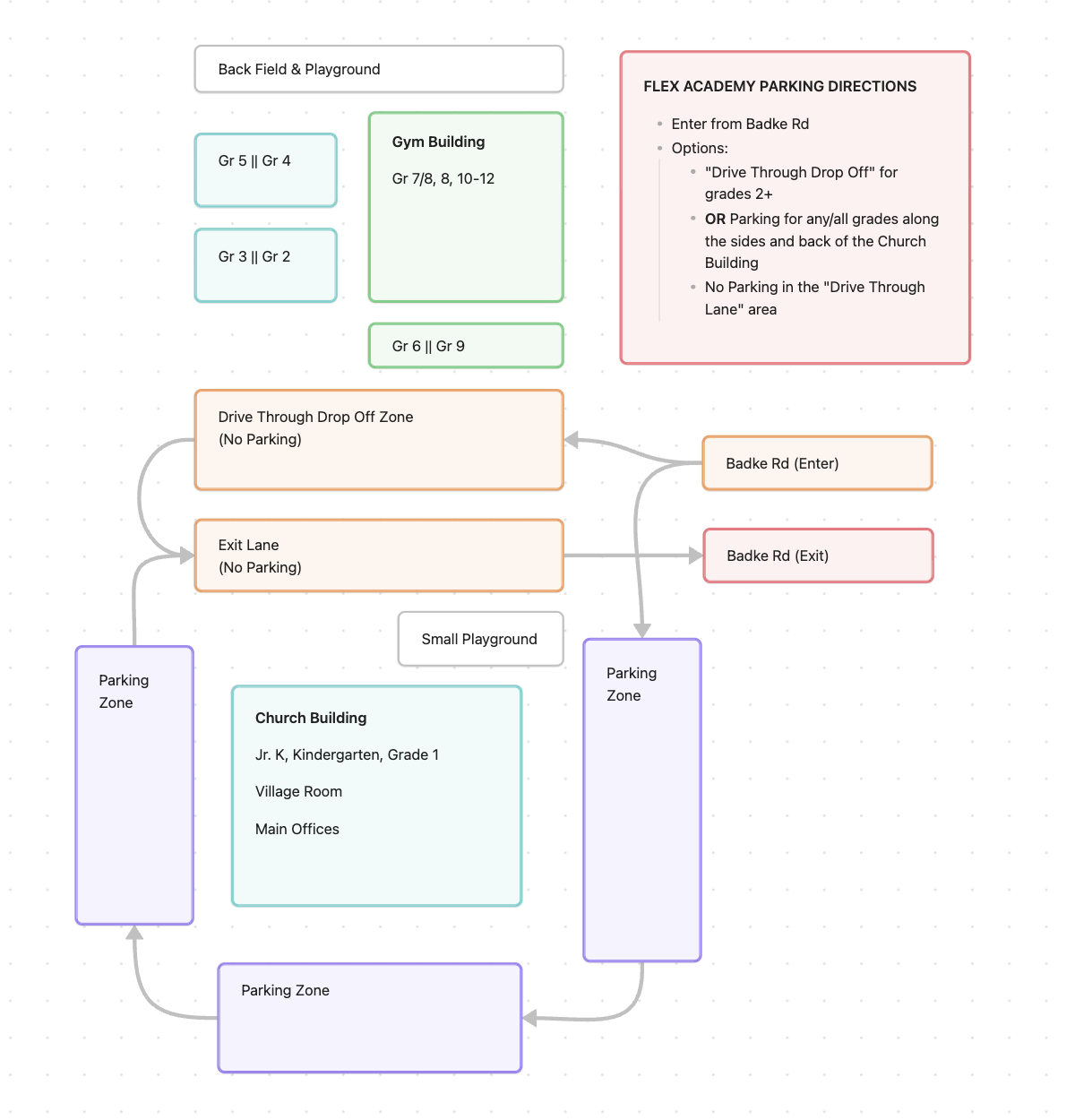
Drop off and pick up for students in JK to grade 1 happens with parents walking their students to the elementary door drop off on the right-hand side of the church building.
Drop off and pickup for students in grades 3-12 is drive-through in the Flex Academy parking lot. Parents/guardians picking up students in grades 3-12 can either do a drive-through pick-up in the Flex Academy parking lot or park in the church's back parking lot.
During the school day, visitors are welcome to park in the middle parking that is between the church and gym buildings.
Risk Management
- All off-site activities require appropriate supervision so that students can be observed and attended to as needed. Supervisors must follow the CRC requirements.
- Supervisors at Flex Academy are always staff members (Teacher, Educational Assistant, Learning Coach, Athletics Coordinator, or Director)
- Any parent supervisors must have a current volunteer CRC on file with Flex Academy before supervising children and must be approved by Administration for supporting in this role.
Student Transportation Policy
Requirements for Volunteer Parent Drivers
All drivers must:
- Be pre-approved by the ministry/dept. head
- Provide a copy of their valid driver’s license via Driver’s Abstract
- Provide a copy of their current auto insurance policy, with a minimum of $3 million liability coverage
- Have a minimum of 5 years driving experience
- Have a CRC clearance letter on file with HCOS
Copies of all driver's licenses and driver's auto insurance need to be kept on file.
Teachers, if you hope to drive for an event, please contact the Director of Flex or Assistant Director of Flex for further details and requirements.